
Antibodies are essential research tools that empower scientists to specify, identify, locate, and quantify protein targets across various scientific fields. As a leading custom antibody provider, we offer comprehensive antibody development and production services, guiding you through every stage—from antigen design to custom antibody generation. Our expert scientists and dedicated technical support team are with you every step of the way.
Data Talks
18+ Years
Antibody Development Experience
>150,000
Successful Projects Delivered
>5,000
Contracted Organizations
Highlights

Proprietary Technologies

One-stop Shop

PhD Level Technical Support

Strict Quality Control
Service Details
Polyclonal Antibody Services
Monoclonal Antibody Services
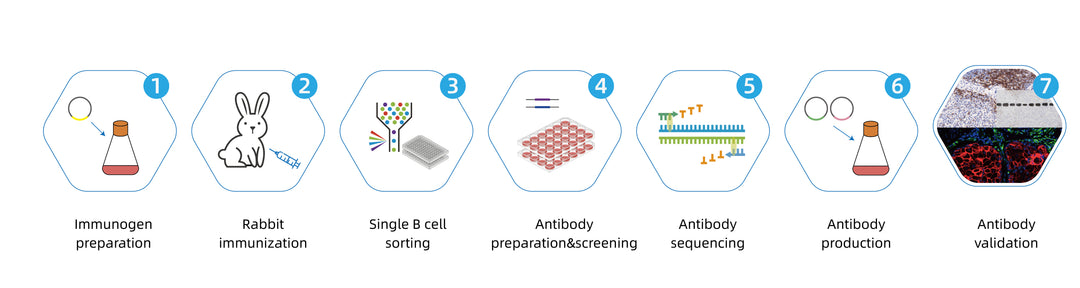
General Workflow of Antibody Development
Frequently Asked Questions
Will I benefit from customer antibody production services?
Antibodies have become essential in various research areas and therapeutic applications. Whether you should use custom antibody production services depends on several factors:
- Specificity Requirements: Do you need antibodies with exceptional specificity to target your antigen precisely?
- Affinity Requirements: Do you need high-affinity antibodies for sensitive detection applications?
- Available Resources: Do you have the expertise and equipment to produce antibodies in-house?
- Timeline Constraints: Do you need high-quality antibodies quickly without extensive optimization?
- Commercial vs. Research Grade: Are you seeking GMP-grade antibodies for therapeutic development?
If you answered yes to any of these questions, our custom antibody production services can provide significant benefits.
Should I use a monoclonal antibody or polyclonal antibody?
Polyclonal Antibodies (pAbs):
- Advantages:
- Recognize multiple epitopes on the same antigen
- Often show high-affinity binding
- Generally more robust across different assay conditions
- Faster and more cost-effective to produce
- Excellent for detection in Western blotting and immunohistochemistry
- Disadvantages:
- Batch-to-batch variability due to animal immunization variation
- May have cross-reactivity with related proteins
- Cannot be propagated indefinitely
Monoclonal Antibodies (mAbs):
- Advantages:
- Highly specific—recognize a single epitope
- Consistent batch-to-batch performance
- Can be produced in unlimited quantities
- Ideal for therapeutic applications requiring high specificity
- Lower cross-reactivity risk
- Disadvantages:
- Generally more expensive and time-consuming to produce
- May require optimization for diverse detection methods
- Sometimes show lower affinity than polyclonals
Recommendation: Choose polyclonal antibodies for applications where multiple epitopes are advantageous and cost-efficiency is critical. Select monoclonal antibodies when you need high specificity, consistency, or large quantities for therapeutic applications.
What types of antigenes can be used for antibody development?
Our custom antibody development services accept a wide range of antigen types:
- Peptides & Protein Fragments: Synthetic peptides (typically 8-20 amino acids) and recombinant protein fragments for targeting specific epitopes
- Recombinant Proteins: His-tagged, GST-tagged, or other engineered protein constructs
- Native/Purified Proteins: Full-length native proteins or naturally purified antigens from tissues or cell lysates
- Whole Cells & Cell Lysates: Mammalian cells, bacterial cells, plant cells, or cell extracts for antibodies against cellular antigens
- DNA/RNA Vaccines: Expression vectors and plasmids encoding target antigens
- Small Molecules: Haptens conjugated to carrier proteins for immunization against small molecular targets
- Anti-Idiotype Antibodies: Antibodies against other antibodies for research and therapeutic applications
Our scientific team will help select the optimal antigen format and immunization strategy to maximize antibody quality and yield.
How to modify a reagent antibody to a potential therapeutic antibody for human diseases?
Converting a research-grade antibody into a therapeutic candidate requires several key modifications:
- Humanization:
- Replace murine or other non-human antibody framework regions with human sequences
- Preserve complementarity-determining regions (CDRs) for target recognition
- Reduces immunogenicity in human patients and improves serum half-life
- Affinity Maturation:
- Use directed mutagenesis or phage display to identify variants with higher binding affinity
- Optimize for improved target selectivity and reduced off-target effects
- Enhances therapeutic efficacy at lower doses
- GMP Manufacturing:
- Establish manufacturing processes under Good Manufacturing Practice (GMP) guidelines
- Ensure quality, purity, and consistency across production batches
- Regulatory Compliance:
- Conduct preclinical safety, pharmacokinetics, and immunogenicity studies
- Prepare IND (Investigational New Drug) application for regulatory approval
HUABIO offers consultative services to guide antibody engineering for therapeutic development.