
We are committed to providing customers with one-stop, high-quality customized solutions for modified-specific antibody preparation. Modified antibodies (such as phosphorylation, methylation, acetylation, lactylation, succinylation, ubiquitination, glycosylation antibodies, etc.) are core tools for in-depth exploration of protein post-translational modification (PTM) functions, and have irreplaceable value in signal pathway research, disease mechanism analysis (such as cancer, neurodegenerative diseases), biomarker discovery and drug development.
Based on advanced antigen design concepts, mature immune technology platforms and rigorous quality control processes, Huabio customizes high-affinity, high-specificity antibodies for specific PTM sites for you. We provide full-service from antigen peptide design and synthesis to final antibody purification and validation, supporting both polyclonal antibody (pAb) and monoclonal antibody (mAb) development pathways to meet your different application scenarios and budget needs.
Custom Services
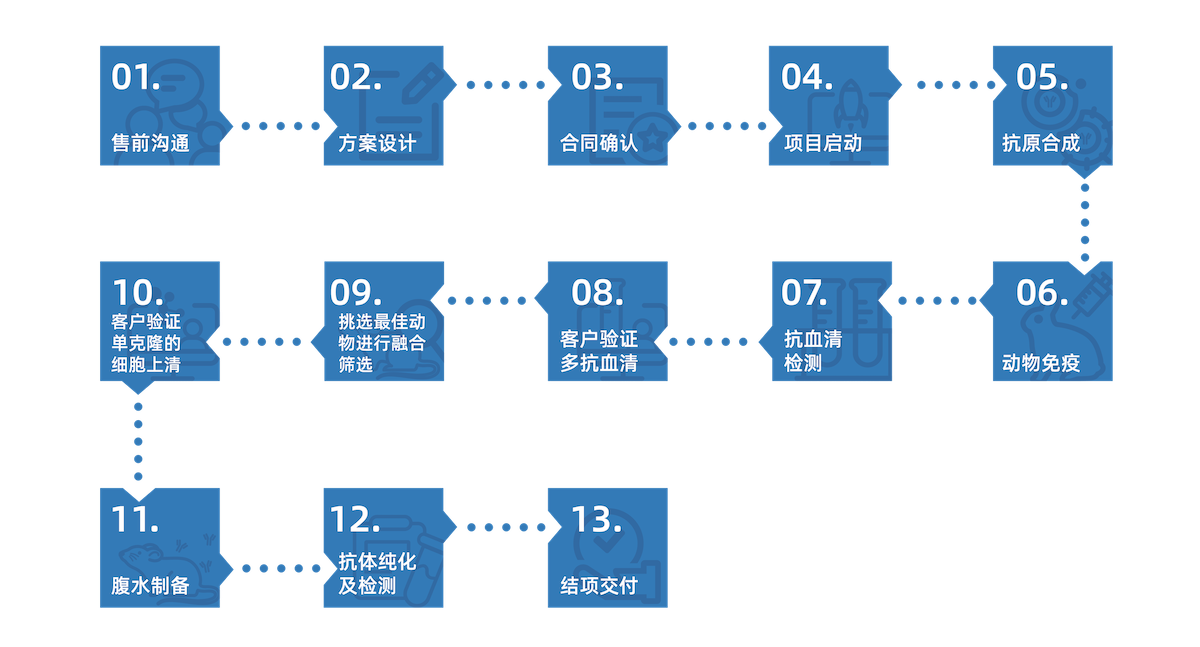
Service Process (Taking Monoclonal Antibodies as an Example)
How to Choose? -- Polyclonal or Monoclonal?
| Characteristic | Polyclonal Antibody (pAb) | Monoclonal Antibody (mAb) |
|---|---|---|
| Composition | Heterogeneous mixture, recognizes multiple epitopes | Homogeneous, recognizes a single epitope |
| Specificity | High, but may contain non-specific antibodies | Extremely high, strictly screened |
| Affinity | Usually high (mixed effect) | Single, may be high or low |
| Batch Variability | Yes | No |
| Production Cycle | Shorter (3-4 months) | Longer (5-6 months) |
| Cost | Lower | Higher |
| Application Scenario | Detection of denatured or modified proteins (WB, IHC, etc.), rapid validation of new targets | Diagnostic reagent development, therapeutic antibody development, experiments requiring absolute consistency |
Recommendation: If you need to obtain antibodies quickly and economically for preliminary research (such as WB), polyclonal is the ideal choice. If your project requires extremely high specificity, no batch differences and is used for long-term research or commercial development, we strongly recommend choosing the monoclonal route.
Service Advantages
1. Precise Design: In-depth bioinformatics analysis to ensure optimal antigen design.
2. Dual Purification Strategy (for Polyclonal Antibodies): Adopting 'positive screening + negative selection' purification strategy, greatly improving antibody specificity.
3. Strict Screening Standards (for Monoclonal Antibodies): Taking 'non-binding to unmodified peptides' as the gold standard, ensuring truly PTM-specific monoclonal antibodies.
Translation missing: en.pages.custom_service_modified.service_advantage.point4
Translation missing: en.pages.custom_service_modified.service_advantage.point5
Customer Provides
1. Fill out the complete project information collection form, including information such as the species, sequence, modification site, modification type, and application of the target gene.
2. If it is a relatively novel modification type, you need to provide references and the chemical structural formula of the modified amino acid, so that we can evaluate whether the corresponding modified polypeptide can be synthesized.
Final Delivery
Polyclonal Antibody:
1. Purified antibodies: 1-2mg of modification-specific antibodies.
2. Remaining serum: Deliver all remaining antiserum according to purification conditions.
3. Report: Deliver a complete project report (including experimental procedures, detection data).
Monoclonal Antibody:
1. Purified antibodies: Deliver 1-2 clones of purified antibodies, providing 5-10mg per clone.
2. Cell lines: Provide 2-5 positive monoclonal cell lines according to customer requirements.
3. Report: Deliver a complete project report (including experimental procedures, screening and detection data).